


Page 22 - Reside Magazine Briggs Freeman
P. 22
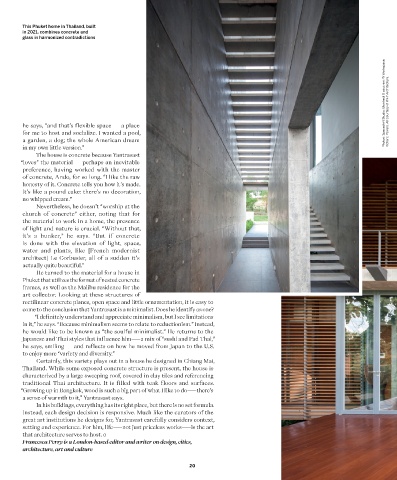
This Phuket home in Thailand, built
        in 2021, combines concrete and
        glass in harmonized contradictions


                                                                                                                               Photos: Spaceshift Studio; Manfredi Gioacchini; W Workspace;  Richard Powers. All Courtesy of WHY Architecture.


        he says, “and that’s f lexible space—a place
        for me to host and socialize. I wanted a pool,
        a garden, a dog; the whole American dream
        in my own little version.”
             The house is concrete because Yantrasast
        “loves” the material—perhaps an inevitable
        preference,  having  worked  with  the  master
        of concrete, Ando, for so long. “I like the raw
        honesty of it. Concrete tells you how it’s made.
        It’s like a pound cake: there’s no decoration,
        no whipped cream.”
             Nevertheless, he doesn’t “worship at the
        church  of  concrete”  either,  noting  that  for
        the material to work in a home, the presence
        of light and nature is crucial. “Without that,
        it’s  a  bunker,”  he  says.  “But  if  concrete
        is  done  with  the  elevation  of  light,  space,
        water  and  plants,  like  [French  modernist
        architect]  Le  Corbusier,  all  of  a  sudden  it’s
        actually quite beautiful.”
             He turned to the material for a house in
        Phuket that utilizes the format of nested concrete
        frames, as well as the Malibu residence for the
        art collector. Looking at these structures of
        rectilinear concrete planes, open space and little ornamentation, it is easy to
        come to the conclusion that Yantrasast is a minimalist. Does he identify as one?
            “I definitely understand and appreciate minimalism, but I see limitations
        in it,” he says. “Because minimalism seems to relate to reductionism.” Instead,
        he would like to be known as “the soulful minimalist.” He returns to the
        Japanese and Thai styles that influence him—a mix of “sushi and Pad Thai,”
        he says, smiling—and ref lects on how he moved from Japan to the U.S.
        to enjoy more “variety and diversity.”
             Certainly, this variety plays out in a house he designed in Chiang Mai,
        Thailand. While some exposed concrete structure is present, the house is
        characterized by a large sweeping roof, covered in clay tiles and referencing
        traditional  Thai  architecture.  It  is  filled  with  teak  f loors  and  surfaces.
        “Growing up in Bangkok, wood is such a big part of what I like to do—there’s
        a sense of warmth to it,” Yantrasast says.                                                                              Photos: Steven Ko; Ozan Gür; HDP Photography; Yellowdot; Keith Chan.
             In his buildings, everything has its right place, but there is no set formula.
        Instead, each design decision is responsive. Much like the curators of the
        great art institutions he designs for, Yantrasast carefully considers context,
        setting and experience. For him, life—not just priceless works—is the art
        that architecture serves to host. 0
        Francesca Perry is a London-based editor and writer on design, cities,
        architecture, art and culture

                                                               20

