


Page 18 - Reside Magazine Briggs Freeman
P. 18
The Soulful Minimalist


               n the world of top-tier art museums, Kulapat Yantrasast is a name
               on everyone’s lips. With his architecture firm, WHY, he designed
               the renovation of the Rockefeller Wing at The Metropolitan Museum
               of Art in New York, which opened in May; has been lead architect
        I for Thailand’s first contemporary art museum, Dib Bangkok, opening
               in December; and was selected by the Louvre in Paris to design the new
        Department of Byzantine and Eastern Christian Art,  set to open in 2027.
             Such accolades build on a decades-long career. Thai-born Yantrasast
        learned his craft with Pritzker prize-winning Japanese architect Tadao Ando
        in Tokyo before moving to the U.S. and establishing WHY in 2004. The firm—
        now based between Los Angeles and New York—designs cultural and
        residential  buildings,  as  well  as  landscape  projects,  but  has  earned
        a reputation for its museum work, becoming a favored architecture practice
        among art circles. WHY designed the Grand Rapids Art Museum in Michigan
        and  the  Speed  Art  Museum  in  Kentucky,  as  well  as  spaces  for  the  Art
        Institute of Chicago, LA’s Academy Museum of Motion Pictures and the
        American Museum of Natural History in New York.
            “I always say that I’m the matchmaker between art and people,” explains
        Yantrasast. He loves museums as places of “empathy and understanding,”
        where people can learn about global culture, and he wants visitors to his projects
        to feel “uplifted.” Whether for the Met or the Louvre, he designs spaces that
        aim to be appropriate for the art and artifacts within, but also instilled with
        a sense of place—and comfort. “Most people feel intimidated by museums,”
        he says, “but I want people to feel confident to explore.”
             While working with storied New York and Paris institutions means
        innovating within set parameters, Yantrasast has enjoyed more free rein with
        Dib Bangkok. An initiative of the late Thai businessman Petch Osathanugrah,
        and featuring his vast collection, the museum aims to put contemporary art
        from Thailand and Southeast Asia “on the same level” as international art, says
        Yantrasast—a vision shared by both the patron and designer.
             The site is a 1980s warehouse in downtown Bangkok, reimagined by
        WHY as a space for art. Minimal, open and flexible, the cavernous structure
        balances precision and passion. “With new museums, I think it’s so important
        to  have  a  sense  of  soul,”  says  Yantrasast.  Nevertheless,  he  didn’t  want
        the building to overpower its contents. “Artists don’t want to display their
        art within architecture that pretends to be sculpture,” he says. Yantrasast
        sees architecture’s greatest power in its ability to “host”—in that way,
        the monumental yet restrained building leaves space for all the activities
        and works that will fill it.
             Flexibility and flow were priorities. “I love the feeling of togetherness
        and openness,” says Yantrasast. “I want people to be able to see each other.”
        This is an idea he returns to frequently: the architect—and architecture—as
        connector. Having lived and worked in Thailand, Japan and the U.S., Yantrasast
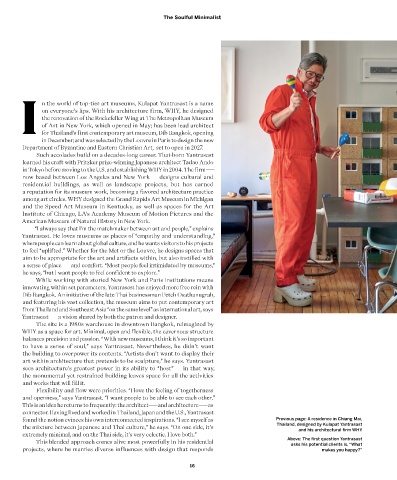
        found the notion evinces his own interconnected inspirations. “I see myself as     Previous page: A residence in Chiang Mai,
        the mixture between Japanese and Thai culture,” he says. “On one side, it’s        Thailand, designed by Kulapat Yantrasast
                                                                                                   and his architectural firm WHY
        extremely minimal, and on the Thai side, it’s very eclectic. I love both.”
             This blended approach comes alive most powerfully in his residential              Above: The first question Yantrasast
                                                                                                asks his potential clients is, “What
        projects, where he marries diverse inf luences with design that responds                          makes you happy?”

                                                               16

