


Page 21 - Reside Magazine Briggs Freeman
P. 21
Reside — Fall 2025


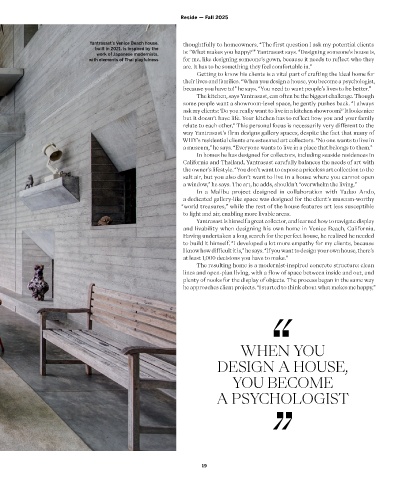
                              Yantrasast’s Venice Beach house,   thoughtfully to homeowners. “The first question I ask my potential clients
                                built in 2021, is inspired by the   is: ‘What makes you happy?’” Yantrasast says. “Designing someone’s house is,
                                 work of Japanese modernists,
                              with elements of Thai playfulness  for me, like designing someone’s gown, because it needs to reflect who they
                                                             are. It has to be something they feel comfortable in.”
                                                                 Getting to know his clients is a vital part of crafting the ideal home for
                                                             their lives and families. “When you design a house, you become a psychologist,
                                                             because you have to!” he says. “You need to want people’s lives to be better.”
                                                                 The kitchen, says Yantrasast, can often be the biggest challenge. Though
                                                             some people want a showroom-level space, he gently pushes back. “I always
                                                             ask my clients: ‘Do you really want to live in a kitchen showroom?’ It looks nice
                                                             but it doesn’t have life. Your kitchen has to reflect how you and your family
                                                             relate to each other.” This personal focus is necessarily very different to the
                                                             way Yantrasast’s firm designs gallery spaces, despite the fact that many of
                                                             WHY’s residential clients are esteemed art collectors. “No one wants to live in
                                                             a museum,” he says. “Everyone wants to live in a place that belongs to them.”
                                                                 In homes he has designed for collectors, including seaside residences in
                                                             California and Thailand, Yantrasast carefully balances the needs of art with
                                                             the owner’s lifestyle. “You don’t want to expose a priceless art collection to the
                                                             salt air, but you also don’t want to live in a house where you cannot open
                                                             a window,” he says. The art, he adds, shouldn’t “overwhelm the living.”
                                                                 In  a  Malibu  project  designed  in  collaboration  with  Tadao  Ando,
                                                             a dedicated gallery-like space was designed for the client’s museum-worthy
                                                            “world treasures,” while the rest of the house features art less susceptible
                                                             to light and air, enabling more livable areas.
                                                                 Yantrasast is himself a great collector, and learned how to navigate display
                                                             and livability when designing his own home in Venice Beach, California.
                                                             Having undertaken a long search for the perfect house, he realized he needed
                                                             to build it himself. “I developed a lot more empathy for my clients, because
                                                             I know how difficult it is,” he says. “If you want to design your own house, there’s
                                                             at least 1,000 decisions you have to make.”
                                                                 The resulting home is a modernist-inspired concrete structure: clean
                                                             lines and open-plan living, with a flow of space between inside and out, and
                                                             plenty of nooks for the display of objects. The process began in the same way
                                                             he approaches client projects. “I started to think about what makes me happy,”


                                                                                          “


                                                                               WHEN YOU

                                                                        DESIGN A HOUSE,

                                                                             YOU BECOME

                                                                        A PSYCHOLOGIST
                                                                                          ”


                                                                   19

