


Page 27 - Reside Magazine Briggs Freeman
P. 27
Reside — Fall 2025


                             “                               T            raditionally, the job of sculpture in a garden or landscape has


                                                                          been as an eyecatcher: picture an imposing classical statue at
                                                                          the end of an allée of trees in an ancestral estate, or a simpler
                  SCULPTURE                                               piece, offering a solid conclusion to a path between two flower
                                                                          beds or hedges.
                                                                               Sculpture brings a sense of permanence and timelessness
              GROWS IN THE                                   to a garden. It looks on, unchanging, at its surroundings, from the first snowdrops
                                                             in January, through the burst of spring and summer color, to the frosted rime
                 OPEN LIGHT                                  A sculpture that seems to float on a stretch of tranquil, dark water, enclosed
                                                             on the withered stems of December. But it does more: it is looked on, too.
             AND WITH THE                                    by greenery, can lower the blood pressure as you gaze at it, while a bright bed
                                                             of tulips reflected in a highly polished piece can lift the spirits.
                 MOVEMENT                                    that reopened in May, showcases the work of some of the world’s finest sculptors
                                                                 Storm King Art Center, the outdoor museum in New York’s Hudson Valley
                  OF THE SUN                                 across its 500 acres. Visitors can experience large-scale work by artists including
                             ”                               of art can be seen to their best advantage.
                                                             Carl Andre, Louise Bourgeois and Alexander Calder and appreciate, from the
                                                             location of sculptures among these hills, fields and woods, how important pieces

                                                                 Here, Andy Goldsworthy’s “Storm King Wall,” 1997–98, a 2,278-foot
                                                             dry-stone wall made the traditional way without mortar, takes a winding path
                                                             through woodland, descending into a pond and emerging the other side to
                                                             continue its snaking course; a work of great beauty.
                                                                                          On a more domestic scale, The Hannah
                                                                                     Peschar Sculpture Garden sits in the grounds of
                                                                                     a 15th-century cottage just an hour outside
                                                                                     London. Established in the 1980s, the garden’s
                                                                                     mature  trees  and  ponds,  fringed  with  bold
                                                                                     architectural plants, form the backdrop for an
                                                                                     annual exhibition of works by more than 50
                                                                                     sculptors. Each piece is carefully sited to take
                                                                                     advantage of the sun or dappled shade, and
                                                                                     visitors  are  given  a  photographic  guide
                                                                                     and suggested route, though the directions (and
                                                                                     opening times) are idiosyncratically British.
                                                                                          Curator Vikki Leedham oversees hundreds
                                                                                     of  sculptures  here  every  year  and  aims  for
                                                                                     a synergy between the art and its surroundings.
                                                                                     She has practical suggestions for introducing
                                                                                     sculpture  to  your  own  garden—but  only


                                                                                               Previous page: Samuel Salcedo’s “Gouttes
                                                                                                       de Pluie,” 2016, at Les Jardins
                                                                                                            d’Etretat in Normandy
                                                                                                  Opposite: Ellsworth Kelly’s “Untitled,”
                                                                                                     1982, at Storm King Art Center in
                                                                                                           Mountainville, New York
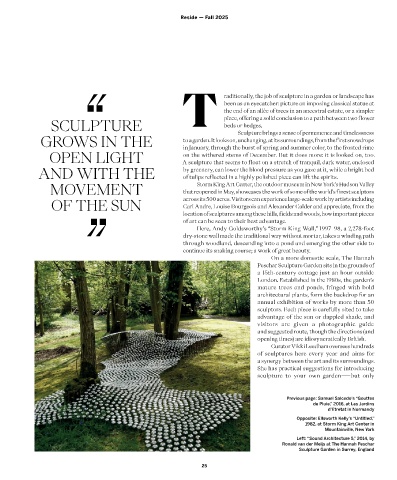
                                                                                                  Left: “Sound Architecture 5,” 2014, by
                                                                                             Ronald van der Meijs at The Hannah Peschar
                                                                                                   Sculpture Garden in Surrey, England

                                                                   25

