


Page 28 - Reside Magazine Briggs Freeman
P. 28
Sculpture for all Seasons


        one rule: “Don’t place your piece in the middle of the lawn. It’s impractical
        (you have to mow around it) and aesthetically unsatisfactory.”
             Building a sculpture garden, even from a single work, begins with
        observation. “Look for good backgrounds in the garden that will enhance
        the piece you are thinking of buying,” says Leedham. “To choose a site, look
        at how the light changes through the day in different parts of the space.
        It is good to discover sculpture as you walk through a garden.”
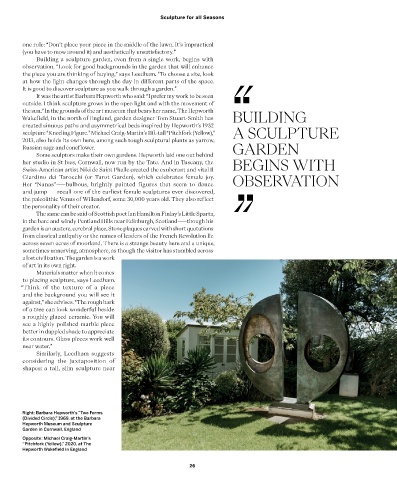
             It was the artist Barbara Hepworth who said: “I prefer my work to be seen
        outside. I think sculpture grows in the open light and with the movement of   “
        the sun.” In the grounds of the art museum that bears her name, The Hepworth
        Wakefield, in the north of England, garden designer Tom Stuart-Smith has   BUILDING
        created sinuous paths and asymmetrical beds inspired by Hepworth’s 1932
        sculpture “Kneeling Figure.” Michael Craig-Martin’s 11ft-tall “Pitchfork (Yellow),”   A SCULPTURE
        2013, also holds its own here, among such tough sculptural plants as yarrow,
        Russian sage and coneflower.                                         GARDEN
             Some sculptors make their own gardens. Hepworth laid one out behind
        her studio in St Ives, Cornwall, now run by the Tate. And in Tuscany, the      BEGINS WITH
        Swiss-American artist Niki de Saint Phalle created the exuberant and vital Il
        Giardino  dei  Tarocchi  (or  Tarot  Garden),  which  celebrates  female  joy.     OBSERVATION
        Her  “Nanas”—bulbous,  brightly  painted  figures  that  seem  to  dance
        and jump—recall one of the earliest female sculptures ever discovered,
        the paleolithic Venus of Willendorf, some 30,000 years old. They also reflect
        the personality of their creator.
             The same can be said of Scottish poet Ian Hamilton Finlay’s Little Sparta,   ”
        in the bare and windy Pentland Hills near Edinburgh, Scotland—though his
        garden is an austere, cerebral place. Stone plaques carved with short quotations
        from classical antiquity or the names of leaders of the French Revolution lie
        across seven acres of moorland. There is a strange beauty here and a unique,
        sometimes unnerving, atmosphere, as though the visitor has stumbled across
        a lost civilization. The garden is a work
        of art in its own right.
             Materials matter when it comes
        to placing sculpture, says Leedham.
        “Think  of  the  texture  of  a  piece
        and the background you will see it
        against,” she advises. “The rough bark
        of a tree can look wonderful beside
        a roughly glazed ceramic. You will
        see a highly polished marble piece
        better in dappled shade to appreciate
        its contours. Glass pieces work well
        near water.”
             Similarly,  Leedham  suggests
        considering  the  juxtaposition  of
        shapes:  a  tall,  slim  sculpture  near


        Right: Barbara Hepworth’s “Two Forms
        (Divided Circle),” 1969, at the Barbara
        Hepworth Museum and Sculpture
        Garden in Cornwall, England
        Opposite: Michael Craig-Martin’s
        “Pitchfork (Yellow),” 2020, at The
        Hepworth Wakefield in England

                                                               26

