


Page 43 - Reside Magazine Briggs Freeman
P. 43
Reside — Fall 2025


                                   Beyoğlu, in the                      weeping uphill from where the Golden Horn’s waters lap at the
                               heart of Istanbul,            S          Karaköy docks to the broad expanse of Taksim Square, the part
                                                                        of Istanbul historically known as Galata and Pera has always stood
                             retains its cultural                       apart. In fact, Pera means “the other side” in Greek, referring to
                                                                        its position on the opposite shore from the seat of the Byzantine
                                   cachet despite                       and Ottoman empires.
                                                                 “We entered a street that curved this way and that, full of nooks and
                           centuries of change,              corners. Every house was a shop offering herbs, bread, meat or clothes,” the
                          writes local resident              Danish writer Hans Christian Andersen observed during an 1841 visit to
                                                             the area. “We met people from every corner of the world… What a crowd there
                                 Jennifer Hattam             was and what chaos and confusion!”
                                                                 Now  part  of  the  larger  Beyoğlu  district  of  modern  Istanbul,  with
                                                             a population of 217,000 people, this area is where Genoese, Venetian, Greek,
                                                             Armenian  and  Jewish  communities  established  themselves  over  many
                                                             centuries, creating a cosmopolitan spirit that lingers to this day.
                                                                                                     .
                                                                 The  main  thoroughfare  of  Beyoğlu  is  Istiklal  Caddesi,  formerly
                                                             the Grande Rue de Péra, a mile-long pedestrian promenade lined with stately
                                                             turn-of-the-20th-century  stone  apartment  buildings  and  still  filled
                                                             with a cacophony of sights, smells, sounds and languages. Touts call out to
                                                             tourists as the conductor of the historic red-and-white tram rings his bell for
                                                             the crowds to give way and music wafts down from rooftop bars.
                                                                 “The whole street is a performance, with a rhythm of its own; you feel
                                                                                                             .
                                                             like anything can happen when you are walking down I  stiklal,” says art
                                                             curator Didem Yazıcı, the director of exhibitions at Yapı Kredi Kültür Sanat,


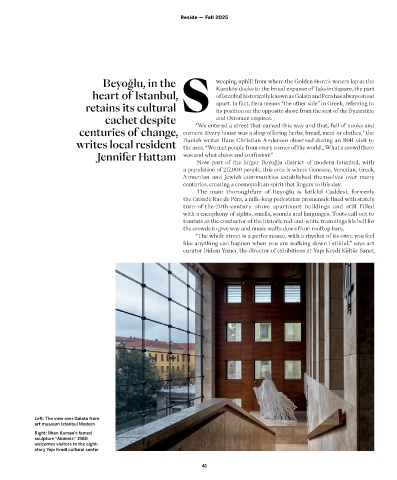
            Left: The view over Galata from
            art museum Istanbul Modern
            Right: İlhan Koman’s famed
            sculpture “Akdeniz,” 1980,
            welcomes visitors to the eight-
            story Yapı Kredi cultural center

                                                                   41

