


Page 41 - Reside Magazine Briggs Freeman
P. 41
Reside — Fall 2025
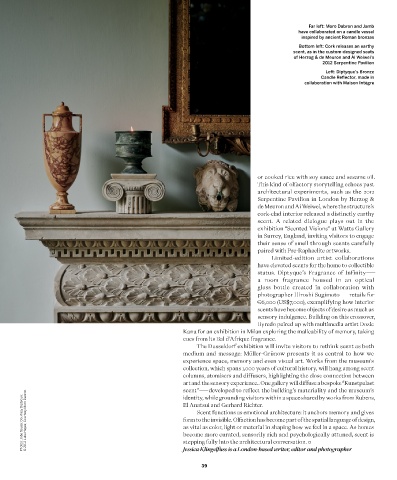
                                                                                                      Far left: Moro Dabron and Jamb
                                                                                                  have collaborated on a candle vessel
                                                                                                   inspired by ancient Roman bronzes
                                                                                                   Bottom left: Cork releases an earthy
                                                                                                 scent, as in the custom-designed seats
                                                                                                 of Herzog & de Meuron and Ai Weiwei’s
                                                                                                          2012 Serpentine Pavilion
                                                                                                           Left: Diptyque’s Bronze
                                                                                                          Candle Reflector, made in
                                                                                                    collaboration with Maison Intègre


                                                                                     or cooked rice with soy sauce and sesame oil.
                                                                                     This kind of olfactory storytelling echoes past
                                                                                     architectural  experiments,  such  as  the  2012
                                                                                     Serpentine Pavilion in London by Herzog &
                                                                                     de Meuron and Ai Weiwei, where the structure’s
                                                                                     cork-clad interior released a distinctly earthy
                                                                                     scent.  A  related  dialogue  plays  out  in  the
                                                                                     exhibition “Scented Visions” at Watts Gallery
                                                                                     in Surrey, England, inviting visitors to engage
                                                                                     their sense of smell through scents carefully
                                                                                     paired with Pre-Raphaelite artworks.
                                                                                          Limited-edition  artist  collaborations
                                                                                     have elevated scents for the home to collectible
                                                                                     status.  Diptyque’s  Fragrance  of  Infinity—
                                                                                     a  room  fragrance  housed  in  an  optical
                                                                                     glass  bottle  created  in  collaboration  with
                                                                                     photographer Hiroshi Sugimoto—retails for
                                                                                     €6,000 (US$7,000), exemplifying how interior
                                                                                     scents have become objects of desire as much as
                                                                                     sensory indulgence. Building on this crossover,
                                                                                     Byredo paired up with multimedia artist Dozie
                                                             Kanu for an exhibition in Milan exploring the malleability of memory, taking
                                                             cues from its Bal d’Afrique fragrance.
                                                                 The Dusseldorf exhibition will invite visitors to rethink scent as both
                                                             medium and message: Müller-Grünow presents it as central to how we
                                                             experience space, memory and even visual art. Works from the museum's
                                                             collection, which spans 1,000 years of cultural history, will hang among scent
                                                             columns, atomisers and diffusers, highlighting the close connection between
                                                             art and the sensory experience.. One gallery will diffuse a bespoke “Kunstpalast
                                                             scent”—developed to reflect the building’s materiality and the museum’s
        Photos: João Sousa; Courtesy Diptyque;   © 2012 Luke Hayes; Courtesy Moro Dabron.  El Anatsui and Gerhard Richter.
                                                             identity, while grounding visitors within a space shared by works from Rubens,
                                                                 Scent functions as emotional architecture: it anchors memory and gives
                                                             form to the invisible. Olfaction has become part of the spatial language of design,
                                                             as vital as color, light or material in shaping how we feel in a space. As homes
                                                             become more curated, sensorily rich and psychologically attuned, scent is
                                                             stepping fully into the architectural conversation. 0
                                                             Jessica Klingelfuss is a London-based writer, editor and photographer

                                                                   39

