


Page 12 - Reside Magazine Briggs Freeman
P. 12
COLLECTI
COLLECTING
N G
Prize Jewels
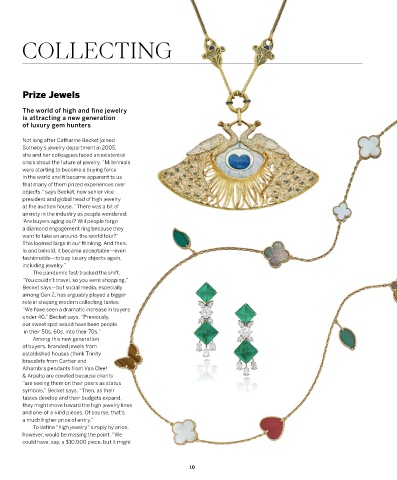
The world of high and fine jewelry
is attracting a new generation
of luxury gem hunters
Not long after Catharine Becket joined
Sotheby’s jewelry department in 2005,
she and her colleagues faced an existential
crisis about the future of jewelry. “Millennials
were starting to become a buying force
in the world and it became apparent to us
that many of them prized experiences over
objects,” says Becket, now senior vice
president and global head of high jewelry
at the auction house. “There was a bit of
anxiety in the industry as people wondered:
‘Are buyers aging out? Will people forgo
a diamond engagement ring because they
want to take an around-the-world tour?’
This loomed large in our thinking. And then,
lo and behold, it became acceptable—even
fashionable—to buy luxury objects again,
including jewelry.”
The pandemic fast-tracked the shift,
“You couldn’t travel, so you went shopping,”
Becket says—but social media, especially
among Gen Z, has arguably played a bigger
role in shaping modern collecting tastes.
“We have seen a dramatic increase in buyers
under 40,” Becket says. “Previously,
our sweet spot would have been people
in their 50s, 60s, into their 70s.”
Among this new generation
of buyers, branded jewels from
established houses (think Trinity
bracelets from Cartier and
Alhambra pendants from Van Cleef
& Arpels) are coveted because clients
“are seeing them on their peers as status
symbols,” Becket says. “Then, as their
tastes develop and their budgets expand,
they might move toward the high jewelry lines
and one-of-a-kind pieces. Of course, that’s
a much higher price of entry.”
To dene “high jewelry” simply by price,
however, would be missing the point. “We Photos: Courtesy Sotheby’s.
could have, say, a $10,000 piece, but it might
10

