


Page 11 - Reside Magazine Briggs Freeman
P. 11
Reside — Fall 2025


                With this growing profile and market
            interest comes a responsibility to represent
            the uniqueness and complexities of the
            culture with accuracy and care. “Indigenous
            art is incredibly diverse,” says Russell-Cook,
            “originating from distinct tribal communities
            across Australia.” Among hundreds of
            Indigenous nations, each with their own
            language and traditions, what unites many
            of the artists is a profound relationship with
            their Country. This term (with a capital C) is
            used to describe their deep connection to
            the land, water, sky, plants, animals, stories,
            songs and even spirits of their area.
                And this relationship shines through in
            the art. The D.C. show features well-known
            names including Rover Thomas, Sally Gabori,
            Albert Namatjira and Emily Kam Kngwarray,
            the latter the subject of a current survey at
            London’s Tate Modern. However, Russell-
            Cook’s selection was led “not by an artist’s
            international reputation but by the want to
            tell a holistic story,” he says. “This is a unique
            opportunity to present real masterpieces
            without compromise.”
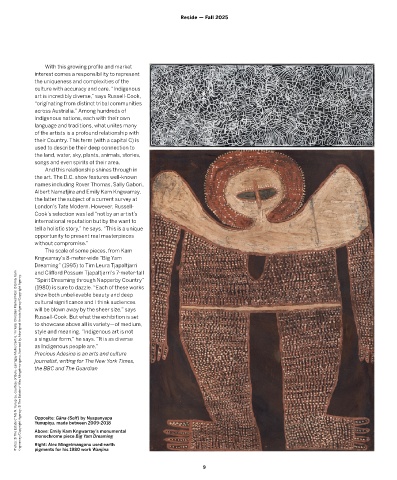
                The scale of some pieces, from Kam
            Kngwarray’s 8-meter-wide “Big Yam
            Dreaming” (1995) to Tim Leura Tjapaltjarri
            and Clifford Possum Tjapaltjarri’s 7-meter-tall
      Photos: © The Estate of Ms N. Yunupiŋu, courtesy of Buku-Larrŋgay Mulka Centre, Yirrkala; Christian Markel/NGV. © Emily Kam
        Kngwarray/Copyright Agency; © The Estate of Alec Mingelmanganu, licensed by Aboriginal Artists Agency/Copyright Agency.
            “Spirit Dreaming through Napperby Country”
            (1980) is sure to dazzle. “Each of these works
            show both unbelievable beauty and deep
            cultural significance and I think audiences
            will be blown away by the sheer size,” says
            Russell-Cook. But what the exhibition is set
            to showcase above all is variety—of medium,
            style and meaning. “Indigenous art is not
            a singular form,” he says. “It is as diverse
            as Indigenous people are.”
            Precious Adesina is an arts and culture
            journalist, writing for The New York Times,
            the BBC and The Guardian


            Opposite: Gäna (Self) by Nyapanyapa
            Yunupiŋu, made between 2009-2018
            Above: Emily Kam Kngwarray’s monumental
            monochrome piece Big Yam Dreaming
            Right: Alec Mingelmanganu used earth
            pigments for his 1980 work Wanjina


                                                                   9

