


Page 44 - Reside Magazine Premier Central Florida
P. 44
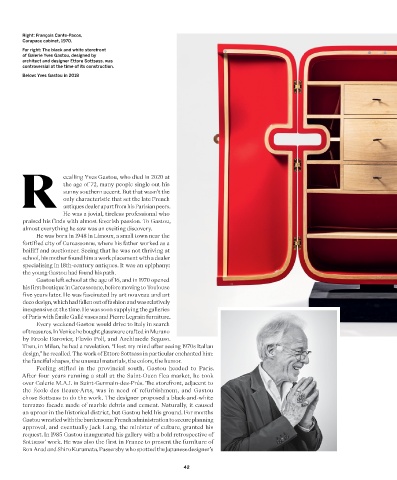
Right: François Cante-Pacos,
        Carapace cabinet, 1970.
        Far right: The black and white storefront
        of Galerie Yves Gastou, designed by
        architect and designer Ettore Sottsass, was
        controversial at the time of its construction.
        Below: Yves Gastou in 2018


        R             ecalling Yves Gastou, who died in 2020 at
                      the age of 72, many people single out his
                      sunny southern accent. But that wasn’t the
                      only characteristic that set the late French
                      antiques dealer apart from his Parisian peers.
                      He was a jovial, tireless professional who
        praised his finds with almost feverish passion. To Gastou,
        almost everything he saw was an exciting discovery.
             He was born in 1948 in Limoux, a small town near the
        fortified city of Carcassonne, where his father worked as a
        bailiff and auctioneer. Seeing that he was not thriving at
        school, his mother found him a work placement with a dealer
        specialising in 18th-century antiques. It was an epiphany:
        the young Gastou had found his path.
             Gastou left school at the age of 16, and in 1970 opened
        his first boutique in Carcassonne, before moving to Toulouse
        five years later. He was fascinated by art nouveau and art
        deco design, which had fallen out of fashion and was relatively
        inexpensive at the time. He was soon supplying the galleries
        of Paris with Émile Gallé vases and Pierre Legrain furniture.
             Every weekend Gastou would drive to Italy in search
        of treasures. In Venice he bought glassware crafted in Murano
        by Ercole Barovier, Flavio Poli, and Archimede Seguso.
        Then, in Milan, he had a revelation. “I lost my mind after seeing 1970s Italian
        design,” he recalled. The work of Ettore Sottsass in particular enchanted him:
        the fanciful shapes, the unusual materials, the colors, the humor.
             Feeling stif led in the provincial south, Gastou headed to Paris.
        After  four  years running a stall at the Saint-Ouen f lea market, he took
        over Galerie M.A.I. in Saint-Germain-des-Prés. The storefront, adjacent to
        the  École  des  Beaux-Arts,  was  in  need  of  refurbishment,  and  Gastou
        chose Sottsass to do the work. The designer proposed a black-and-white
        terrazzo facade made of marble debris and cement. Naturally, it caused
        an uproar in the historical district, but Gastou held his ground. For months
        Gastou wrestled with the burdensome French administration to secure planning
        approval, and eventually Jack Lang, the minister of culture, granted his
        request. In 1985 Gastou inaugurated his gallery with a bold retrospective of
        Sottsass’ work. He was also the first in France to present the furniture of
        Ron Arad and Shiro Kuramata. Passersby who spotted the Japanese designer’s


                                                             42

