


Page 22 - Reside Magazine Premier Central Florida
P. 22
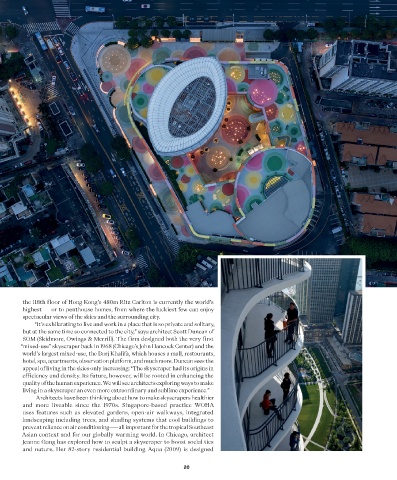
the 118th floor of Hong Kong’s 480m Ritz Carlton is currently the world’s
        highest—or to penthouse homes, from where the luckiest few can enjoy
        spectacular views of the skies and the surrounding city.
            “It’s exhilarating to live and work in a place that is so private and solitary,
        but at the same time so connected to the city,” says architect Scott Duncan of
        SOM (Skidmore, Owings & Merrill). The firm designed both the very first
        “mixed-use” skyscraper back in 1968 (Chicago’s John Hancock Center) and the
        world’s largest mixed-use, the Burj Khalifa, which houses a mall, restaurants,
        hotel, spa, apartments, observation platform, and much more. Duncan sees the
        appeal of living in the skies only increasing: “The skyscraper had its origins in
        efficiency and density. Its future, however, will be rooted in enhancing the
        quality of the human experience. We will see architects exploring ways to make
        living in a skyscraper an even more extraordinary and sublime experience.”
             Architects have been thinking about how to make skyscrapers healthier
        and  more  liveable  since  the  1970s.  Singapore-based  practice  WOHA
        uses  features  such  as  elevated  gardens,  open-air  walkways,  integrated
        landscaping including trees, and shading systems that cool buildings to
        prevent reliance on air conditioning—all important for the tropical Southeast
        Asian context and for our globally warming world. In Chicago, architect
        Jeanne Gang has explored how to sculpt a skyscraper to boost social ties
        and  nature.  Her  82-story  residential  building  Aqua  (2009)  is  designed


                                                             20

