


Page 20 - Reside Magazine Premier Central Florida
P. 20
Previous page: Jeanne Gang’s
                                                                                 Aqua Tower in Chicago mirrors
                                                                                 the hills, valleys, and lakes of
                                                                                 a natural landscape.
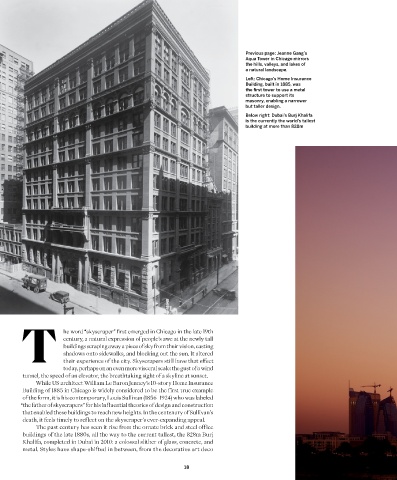
                                                                                 Left: Chicago’s Home Insurance
                                                                                 Building, built in 1885, was
                                                                                 the first tower to use a metal
                                                                                 structure to support its
                                                                                 masonry, enabling a narrower
                                                                                 but taller design.
                                                                                 Below right: Dubai’s Burj Khalifa
                                                                                 is the currently the world’s tallest
                                                                                 building at more than 828m


        T             he word “skyscraper” first emerged in Chicago in the late 19th
                      century, a natural expression of people’s awe at the newly tall
                      buildings scraping away a piece of sky from their vision, casting
                      shadows onto sidewalks, and blocking out the sun. It altered
                      their experience of the city. Skyscrapers still have that effect
                      today, perhaps on an even more visceral scale: the gust of a wind
        tunnel, the speed of an elevator, the breathtaking sight of a skyline at sunset.
             While US architect William Le Baron Jenney’s 10-story Home Insurance
        Building of 1885 in Chicago is widely considered to be the first true example
        of the form, it is his contemporary, Louis Sullivan (1856–1924) who was labeled
        “the father of skyscrapers” for his influential theories of design and construction
        that enabled these buildings to reach new heights. In the centenary of Sullivan’s
        death, it feels timely to reflect on the skyscraper’s ever-expanding appeal.
             The past century has seen it rise from the ornate brick and steel office
        buildings of the late 1880s, all the way to the current tallest, the 828m Burj
        Khalifa, completed in Dubai in 2010: a colossal slither of glass, concrete, and
        metal. Styles have shape-shifted in between, from the decorative art deco


                                                             18

