


Page 53 - Reside Magazine Premier Central Florida
P. 53
director  of  the  botanical  gardens  at  the
                                                                                     Huntington—a  library,  art  museum,  and
                                                                                     botanical garden in Pasadena, California. While
                                                                                     many public gardens are simply meant for human
                                                                                     enjoyment, botanical gardens like those at the
                                                                                     Huntington have a more scientific agenda and
                                                                                     collect plant specimens for a specific purpose.
                                                                                          At the Huntington, the botanical gardens
                                                                                     encompass  nearly  130  acres  and  include  16
                                                                                     themed gardens, ranging from dedicated palm,
                                                                                     jungle, and rose gardens to a Japanese landscape
                                                                                     with  a  ceremonial  teahouse  called  Seifu-an
                                                                                     (“Arbor of Pure Breeze”) and a desert garden with
                                                                                     one of the largest outdoor collections of cacti
                                                                                     and succulents in the world. More than 16,000
                                                                                     species of plants make up the Huntington’s
                                                                                     collection, which complements the collections
                                                                                     of fine art, manuscripts, and rare books on view
                                                                                     inside its celebrated library and art museum.
                                                                                         “Henry  Huntington  was  a  collector  by
                                                                                     nature, so it was very natural for him to collect
                                                                                     plants,” says Cavender of the institution’s
                                                                                     founder,  who  helped  establish  the  electric
                                                                                     railway system in Los Angeles after moving
                                                                                     there  in  1902.  He  purchased  the  Pasadena
                                                                                     property  in  1903  and,  with  his  second  wife
                                                                                     Arabella Duval Huntington, began amassing
                                                                                     the extensive cultural and botanical collections
                                                                                     that  define  the  institution  today,  including
                                                                                     one  of  the  world’s  largest  troves  of  British
                                                                                     medieval  manuscripts,  one  of  12  surviving
                                                                                     copies  on  vellum  of  the  Gutenberg  Bible,
                                                             extensive holdings of Americana and science and technology, as well as
                                                             a very significant collection of British portraiture.
                                                                 While  Huntington  originally  established  the  gardens  to  advance
                                                             his business opportunities for real estate and agriculture in what was a newly
                                                             booming  region—and  to  satisfy  his  collector’s  impulse—today  the
                                                             botanical gardens are frequented by casual visitors as well as horticulturists
                                                             and scholars from around the world. “We have one of the most diverse plant
                                                             collections in the country, if not the world,” says Cavender. “At the same time,
                                                             there’s a magic in the experiential quality of the gardens that Henry Huntington
                                                             established very early on.”
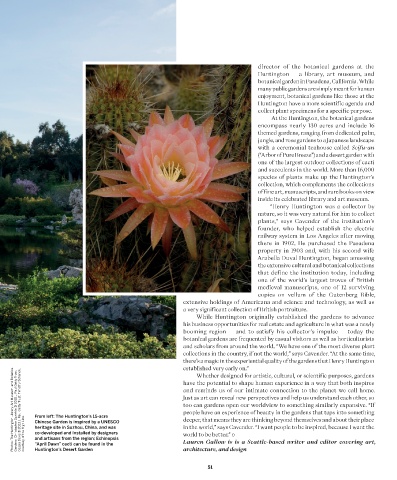
     Photos: The Huntington Library, Art Museum, and Botanical   Gardens; Christopher Sprinkle © 2018 J. Paul Getty Trust;   Cassia Davis © 2023 J. Paul Getty Trust; Timothy Schenck,   courtesy of the High Line.  From left: The Huntington’s 15-acre    and  reminds  us  of  our  intimate  connection  to  the  planet  we  call  home.
                                                                 Whether designed for artistic, cultural, or scientific purposes, gardens
                                                             have the potential to shape human experience in a way that both inspires

                                                             Just as art can reveal new perspectives and help us understand each other, so
                                                             too can gardens open our worldview to something similarly expansive. “If
                                                             people have an experience of beauty in the gardens that taps into something
                                                             deeper, that means they are thinking beyond themselves and about their place
            Chinese Garden is inspired by a UNESCO
                                                             in the world,” says Cavender. “I want people to be inspired, because I want the
            heritage site in Suzhou, China, and was
            co-developed and installed by designers
                                                             world to be better.” 0
            and artisans from the region; Echinopsis
                                                             Lauren  Gallow  is  is  a  Seattle-based  writer  and  editor  covering  art,
            “April Dawn” cacti can be found in the
                                                             architecture, and design
            Huntington’s Desert Garden
                                                                     51

