


Page 30 - Reside Magazine Premier Central Florida
P. 30
E           ver since the first caveman or
                    woman drew a bison, people have
                    loved wall paintings. Amid the
                    remains of Roman Pompeii are
                    beautiful murals of leafy gardens
                    full  of  fruit  trees  and  f lowers
        while, centuries later, Italian Renaissance ducal
        palaces were adorned with frolicking gods and
        goddesses. Early American settlers preferred to
        paint naive landscapes with pale, slender trees
        and limpid lakes, but the Gilded Age of the late
        19th  century  saw  the  walls  and  ceilings  of
        American  mansions  (as  well  as  the  public
        institutions  endowed  by  their  rich  owners)
        decorated with bold, florid designs. Almost all
        at large and smaller scale on walls across the US. Recent projects include   “
        featured  pillowy  clouds;  the  most  enduring
        mural trope throughout the centuries. Now, there are signs that murals are
        making a return, with those historic subjects—with the possible exception
        of the bison—being painted onto American walls.
             The bar at New York’s Le Coucou restaurant in lower Manhattan, with
        its misty, feathery trees, was painted by much-in-demand muralist Dean Barger.
        “I want the viewer to get lost in the illusion,” he says of his work, which he paints   I WANT THE
                                                                         VIEWER TO
        a dreamy moonscape for the Stable Hall music venue in San Antonio, Texas,
        and some nebulous pine trees in the manner of the Japanese artist Hasegawa   GET LOST IN
        Tōhaku (1539–1610) for the newly opened Nami restaurant in Lake Nona, Florida.   THE ILLUSION
             Stephen Alesch of Roman and Williams, the design firm behind Le
        to Italy and Spain. Now 71 and busier than ever, she has a broad portfolio,   ”
        Coucou’s interiors, says: ‘‘I hate those murals where every brushstroke is
        screaming for attention’’—and Barger agrees. Instead, he uses multiple
        diaphanous washes of very dilute artist’s acrylic to create his illusions, “so you
        are never sure if you are looking at a lake or mist on a meadow.”
             The day Anne Harris was fired from a job she disliked, her luck—and
        her life—changed. It finally tipped the artist, a painter from her university
        days, into pursuing the mural painting she had so admired on her many trips

        from pale grisailles of gardens and landscapes to bold panoramas, with a
        wide  frame  of  art  historical  reference.  She  particularly  enjoys  painting
        flowers on a huge scale; some recent pieces measure as much as 8ft by 10ft.
        “I do love a stamen,” she says with a smile.
             Among her projects, Harris has completed a dining room mural for a Dutch
        friend on Central Park West in New York, where a vastly enlarged still-life in
        the style of 17th-century Dutch paintings reveals towering peaks of snowy
        table napkins and massive lemons, their peels curling down to the f loor.
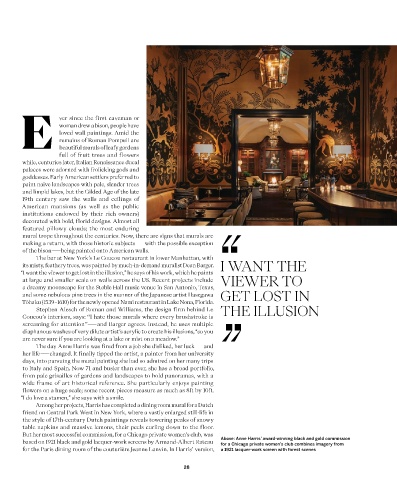
        But her most successful commission, for a Chicago private women’s club, was
        based on 1921 black and gold lacquer-work screens by Armand-Albert Rateau   Above: Anne Harris’ award-winning black and gold commission
                                                                         for a Chicago private women’s club combines imagery from
        for the Paris dining room of the couturière Jeanne Lanvin. In Harris’ version,   a 1921 lacquer-work screen with forest scenes


                                                             28

