


Page 57 - Reside Magazine Briggs Freeman
P. 57
Reside — Fall 2025


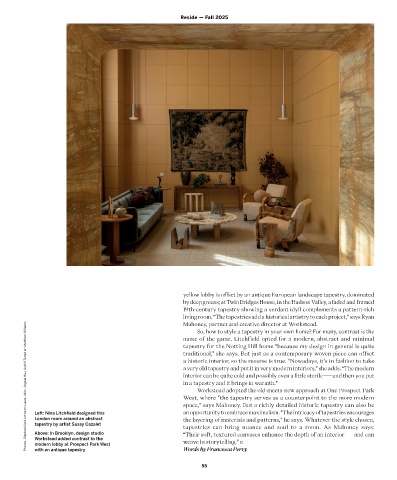
                                                             yellow lobby is offset by an antique European landscape tapestry, dominated
                                                             by deep greens; at Twin Bridges House, in the Hudson Valley, a faded and framed
                                                             19th-century tapestry showing a verdant idyll complements a pattern-rich
                                                             living room. “The tapestries add a historical artistry to each project,” says Ryan
                                                             Mahoney, partner and creative director at Workstead.
          Photos: Stephen Kent Johnson; Laure Joliet; Angela Hau; Astrid Templier; Matthew Williams.
                                                                 So, how to style a tapestry in your own home? For many, contrast is the
                                                             name of the game. Litchfield opted for a modern, abstract and minimal
                                                             tapestry for the Notting Hill home “because my design in general is quite
                                                             traditional,” she says. But just as a contemporary woven piece can offset
                                                             a historic interior, so the reverse is true. “Nowadays, it’s in fashion to take
                                                             a very old tapestry and put it in very modern interiors,” she adds. “The modern
                                                             interior can be quite cold and possibly even a little sterile—and then you put
                                                             in a tapestry and it brings in warmth.”
                                                                 Workstead adopted the old-meets-new approach at One Prospect Park
                                                             West, where “the tapestry serves as a counterpoint to the more modern
                                                             space,” says Mahoney. But a richly detailed historic tapestry can also be
            Left: Nina Litchfield designed this              an opportunity to embrace maximalism. “The intricacy of tapestries encourages
            London room around an abstract                   the layering of materials and patterns,” he says. Whatever the style chosen,
            tapestry by artist Sussy Cazalet
                                                             tapestries  can  bring  nuance  and  soul  to  a  room.  As  Mahoney  says:
            Above: In Brooklyn, design studio                “Their soft, textured canvases enhance the depth of an interior—and can
            Workstead added contrast to the                  weave in storytelling.” 0
            modern lobby at Prospect Park West
            with an antique tapestry                         Words by Francesca Perry

                                                                   55

