


Page 34 - Reside Magazine Briggs Freeman
P. 34
Fun and Games


                                                                                          Previous page: Portia Fox Design uses floor-
       W                   hether  it  is  chess  or  cards,  Monopoly  or  mahjong,    to-ceiling windows to make a basement games
                           chances are you have a favorite game. And maybe even
                                                                                                 room the perfect ambient space
                           a dedicated place within your home to play it. Interior
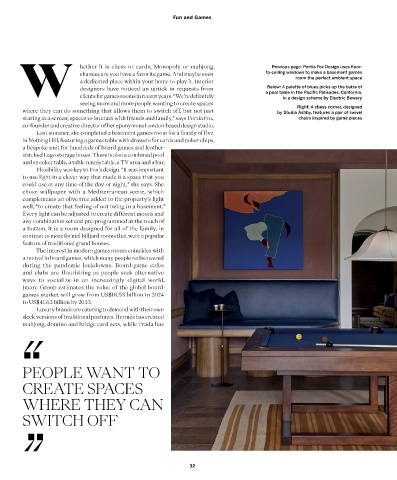
                                                                                        Below: A palette of blues picks up the baize of
                           designers have noticed an uptick in requests from
                           clients for games rooms in recent years. “We’re definitely
                                                                                             in a design scheme by Electric Bowery
                           seeing more and more people wanting to create spaces         a pool table in the Pacific Palisades, California,
                                                                                                  Right: A chess corner, designed
        where they can do something that allows them to switch off, but not just            by Studio Ashby, features a pair of swivel
        staring at a screen; spaces to interact with friends and family,” says Portia Fox,        chairs inspired by game pieces
        co-founder and creative director of her eponymous London-based design studio.
             Last summer, she completed a basement games room for a family of five
        in Notting Hill, featuring a games table with drawers for cards and poker chips,
        a bespoke unit for hundreds of board games and leather-
        stitched Lego storage boxes. There is also a combined pool
        and snooker table, a table tennis table, a TV area and a bar.
             Flexibility was key to Fox’s design. “It was important
        to use light in a clever way that made it a space that you
        could use at any time of the day or night,” she says. She
        chose  wallpaper  with  a  Mediterranean  scene,  which
        complements an olive tree added to the property’s light
        well, “to create that feeling of not being in a basement.”
        Every light can be adjusted to create different moods and
        any combination set and pre-programmed at the touch of
        a button. It is a room designed for all of the family, in
        contrast to more formal billiard rooms that were a popular
        feature of traditional grand houses.
             The interest in modern games rooms coincides with
        a revival in board games, which many people rediscovered
        during  the  pandemic  lockdowns.  Board-game  cafes
        and  clubs  are  f lourishing  as  people  seek  alternative
        ways  to  socialize  in  an  increasingly  digital  world.
        Imarc Group estimates the value of the global board-
        games market will grow from US$18.53 billion in 2024
        to US$41.63 billion by 2033.
             Luxury brands are catering to demand with their own
        sleek versions of traditional pastimes. Hermès has created
        mahjong, domino and bridge card sets, while Prada has
        “


        PEOPLE WANT TO

        CREATE SPACES

        WHERE THEY CAN


        SWITCH OFF
        ”                                                      32

